
Same "build the tool I wish existed" energy as FloAI, but tighter and quicker. Solo affiliate creators were juggling keyword tools, affiliate network tabs, and spreadsheets — with no single place to ask which keywords are worth targeting and which programs can actually monetize them. I designed and shipped ScrapeKey: a live SaaS at scrapekey.com that connects keyword research to affiliate program matching in one workflow. Free SEO tools for discovery, a project-based workspace for scrape and match, Stripe billing for Pro, and closed-beta access controls while invited creators test the experience.
Project overview
The challenge
Affiliate-focused creators typically stitch together Ahrefs or Ubersuggest for keywords, then manually hunt programs across CJ, ShareASale, Impact, or brand sites. Nothing scores a keyword by monetization potential and surfaces ranked affiliate matches in the same workspace. That fragmentation wastes time and leads to two failure modes: targeting keywords that never convert, or joining programs with no clear content angle. I set out to build one product that answers a simple question — which keywords should I target, and which offers can I promote with them?
My role
I owned ScrapeKey end to end as solo founder and full-stack engineer: product definition, brand direction, UX, API design, data modeling, integrations, deployment, and go-to-market documentation. Architectural calls: React on Vercel, FastAPI on Railway, MongoDB Atlas — and I drove production honesty by removing mock data paths from customer-facing flows. During closed beta I also run founder ops: invite codes, allowlisted registration, comped Pro for testers, and feedback via the contact form and support inbox.
Three pillars of the product
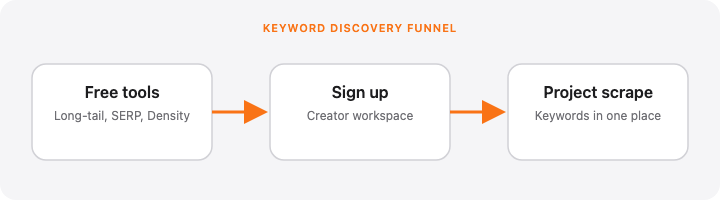
- Keyword discovery: Projects, scrape jobs, and free SEO tools (long-tail generator, SERP preview, keyword density) that feed signup without forcing a credit card first.
- Affiliate matching: A weighted scoring engine that ranks programs by relevance, commission, competition, trend, and performance against each keyword, backed by a live catalog sync (Awin).
- Production SaaS platform: Auth with MFA, Stripe live subscriptions, tiered plan limits, real-time notifications, admin/owner dashboards, and closed-beta gating until public launch.
Exploration & discovery
Mapping the DIY stack
Before writing production code, I documented how solo creators actually work today: keyword tool → spreadsheet → network browsing → content tool → analytics. Competitive research confirmed that SEO suites optimize for agencies and volume metrics, while affiliate directories optimize for browsing programs — neither connects intent to monetization in one loop. That gap became the wedge: ScrapeKey would not try to out-Ahrefs Ahrefs; it would own the path from keyword opportunity to promotable offer.
Defining the product wedge
I locked brand and funnel early: ScrapeKey on scrapekey.com, tagline Scrape keywords. Match offers that pay, and a fox mascot as a flat vector mark (minimal, Apple-influenced marketing shell + gray functional app). Free ScrapeKey Tools act as top-of-funnel; logged-in projects hold scrape results and matches; Pro unlocks deeper limits and paid-tool gates. Agency tier stays "coming soon" so beta focus stays on core creator workflow and Pro validation.
Choosing a production-ready foundation
I prioritized integrations that make the demo defensible in production: MongoDB Atlas for workspace data, Stripe for live Pro billing, SMTP for password reset and contact, and publisher API sync for real affiliate catalog rows — not placeholder cards. Auth hardening (lockout, step-up forgot-password, 15-minute reset tokens, MFA/TOTP, Have I Been Pwned checks) shipped before scaling tester access. AI content generation is wired behind feature flags with structured OpenAI prompts; matching and intent scoring stay deterministic so the product does not overclaim "AI-powered" where rules and data do the work.
Build process
Delivery was phased: free tools and API contracts first, then authenticated workspace (projects, keywords, scrape jobs), then affiliate matching and marketplace views, then billing and operator dashboards, then security hardening and closed beta. Each phase had acceptance checks: pytest for APIs, Playwright smoke in GitHub Actions, and founder walk-throughs documented in QA runbooks. I removed mock fallbacks from production paths so pricing, limits, and match results reflect real server state.
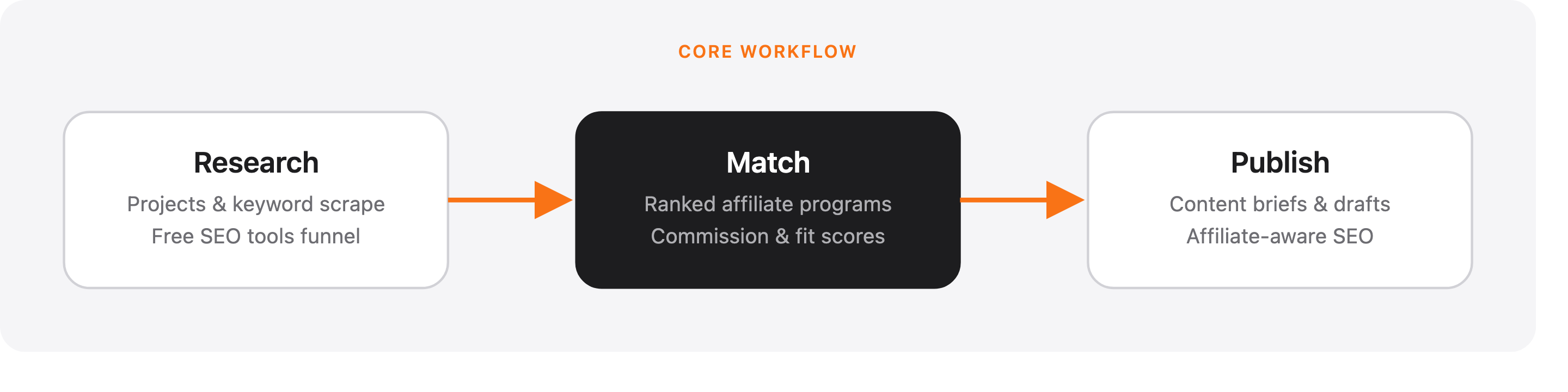
Core workflow: Research → Match → Publish
The in-app loop is deliberate and repeatable: create a project for a niche, run scrape to collect keyword candidates, execute matching against the affiliate catalog, then use matches to inform content (templates today; LLM-assisted briefs on the roadmap). Project-scoped APIs keep data isolated; match rows expose scores recruiters and creators can scan quickly. This workflow is the narrative spine for marketing, portfolio, and future onboarding.
Strategic impact
Shipped a live creator SaaS
ScrapeKey runs in production at scrapekey.com with a cohesive brand, working registration and login, free tools, project workspace, and Stripe live for Pro ($49.99/mo). The site is in closed beta: personal invite codes plus email allowlist on registration, with Pro comped for invited testers during feedback collection. Public launch follows beta learnings — not a fixed calendar date — so quality and positioning stay aligned with real creator use.
Closed the keyword-to-offer gap
The matching engine gives creators ranked affiliate programs per keyword using multi-factor scoring — not manual network tab hunting. Awin catalog sync populates thousands of programs for operator-managed collection and marketplace UX. Free tools provide immediate SEO utility and an honest top-of-funnel; the logged-in product delivers the differentiated match experience competitors spread across separate subscriptions.
Production-grade platform readiness
Beyond the creator UI, ScrapeKey includes admin and owner dashboards, auth audit metrics, plan cap enforcement (projects, enrichment, API usage), contact form to support@scrapekey.com, and deployment runbooks for Railway and Vercel. CI runs E2E smoke on main. Conscious solo-founder tradeoff: deep on wedge and production integrity, with marketing hero visuals and final fox asset polish still on the roadmap — ship beta first, learn from testers, then polish.
Reflections
- Wedge over breadth: competing with full SEO suites on every metric would dilute the story. ScrapeKey wins when keyword research and affiliate matching stay inseparable in one workflow.
- Production honesty early: removing mock data from customer paths was slower upfront but made beta feedback trustworthy — testers react to real limits, real matches, and real billing boundaries.
- Ship, then polish visuals: brand rules and a code-based fox mark shipped; hero photography and portfolio-grade screenshots lagged behind backend and matching work. Closing that visual gap is the next layer for both scrapekey.com and this case study.
Product shots
Swipe for more →